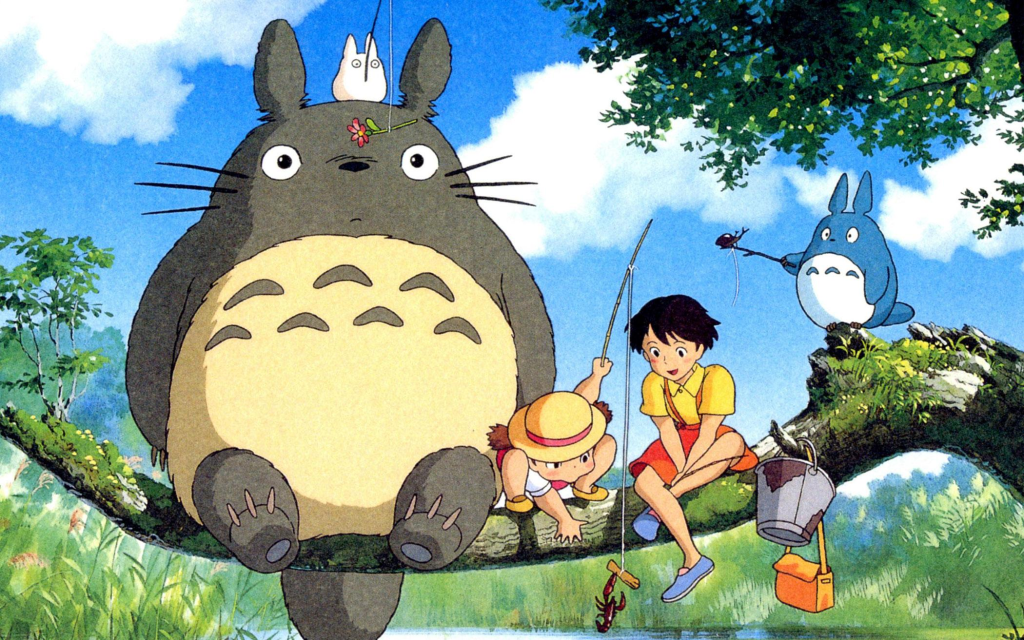
My Neighbor Totoro starts with one summer day in the Japanese countryside. Tatsuo and his two daughters, Satsuki and Mei, arrive in a rattling truck along a winding road, pulling up to a dusty, creaky house that has been empty just long enough. They’ve moved to be closer to the girls’ mother, who is recovering in a nearby hospital. Over the course of the summer, Satsuki and Mei wander through fields and forests, drifting just beyond the tree-lined edges of the ordinary, until they encounter Totoro, a silent (but sensationally cute) spirit of the woods. As they befriend this friendly fuzzball, their quaint countryside quest turns into a hushed wonderland that has invited many viewers like me into a childhood imagination unburdened by urgency or expectation.
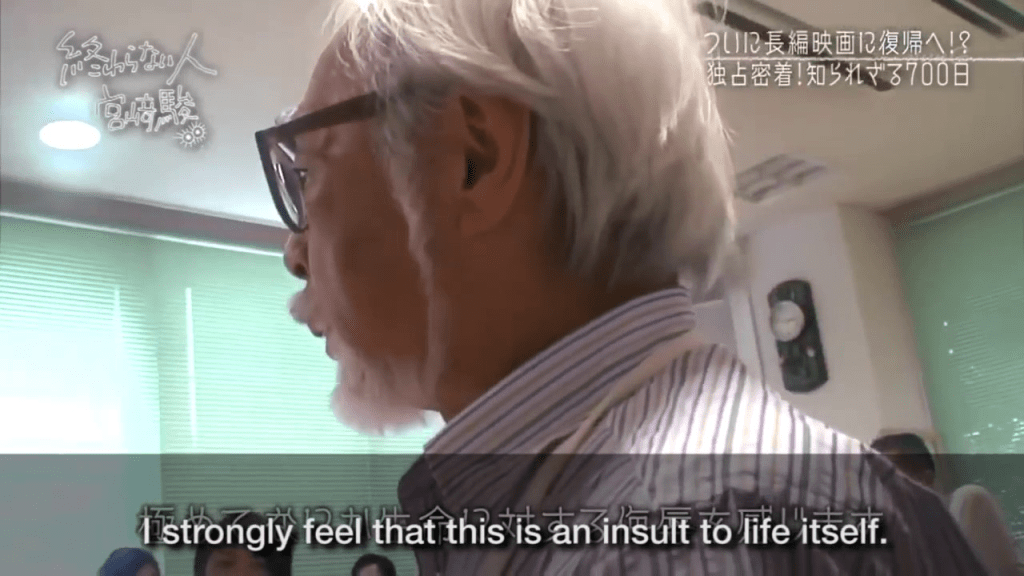
Between the release of Totoro (1988) and pre-ChatGPT era (2022), Miyazaki directed eight more films, each earning both domestic and global acclaim. Over the same period, even as digital tools became more standard in media production, the prevailing view persisted that creativity was difficult to automate and remained a uniquely human trait (Why AI Can’t Take Away Creative Jobs – Forbes, 2024). In 2016, during an NHK documentary, Miyazaki was shown an AI demo designed to generate ‘hard-to-animate’ motions. Though technically novel, Miyazaki dismissed it as “an insult to life itself”.
For much of the pre-GenAI era, this quasi-spiritual view around creativity was pretty prevalent. In 2013, Carl Benedikt Frey and Michael Osborne, an economist and AI researcher at the University of Oxford, published “The Future of Employment“, a widely cited study in the 2010s that shaped policy and public debate on automation. They argued that creative intelligence constitutes an inherent “engineering bottleneck” and is therefore unlikely to be automated. Within this framework that preceded the advent of LLM or agentic AI, automation was expected to primarily affect routine and rule-based tasks. In the meantime, work that requires originality, originality, social interaction and complex perception would remain uniquely human and resistant to A adoption.
However, this distinction began to blur in the early 2020s with the emergence of GenAI. What first startled us was LLM’s ability to produce coherent, context-aware texts. The pace since then has been hard to track. Within two years of ChatGPT’s launch, OpenAI’s 4o image generation tool started generating Ghibli inspired images and memes (See Sam Altman’s tweet). What at first appeared as a shockwave of novelty did not last as a meme. It began to unsettle the foundations of the media industry that trade in imagination itself. In Hollywood, the Writers Guild of America went on a strike in 2023 demanding protections against the use of generative AI to replace or diminish human writers, or used to undermine compensation and authorship.
The breakthroughs observed (or threats perceived) in the creative industry were not isolated in art and media. It stemmed from a deeper shift in how AI systems learn and generate outputs. At the core of its progress is the development of foundation models that became exponentially better at large scale training based on vast body of text, image and data. The models were no longer executing on explicitly programmed rules but instead applying statistical patterns across domains to generate ‘plausible’ outputs across larger contexts. Models trained on large image and text datasets have become able to generate stylistically coherent artwork and texts. In the meantime, in Silicon Valley and San Francisco, models trained on massive code repositories started producing functional code. Starting in 2026, I am seeing more and more software engineer friends here transitioning from individual contributors to managers of Claude agents. If you are curious, take a look at this article (Silicon Valley programmers are now barely programming).
A similar pattern is happening outside of the industries that California dominates too. Here are a few industries with rapid AI adoption in addition to creative industry and software engineering:
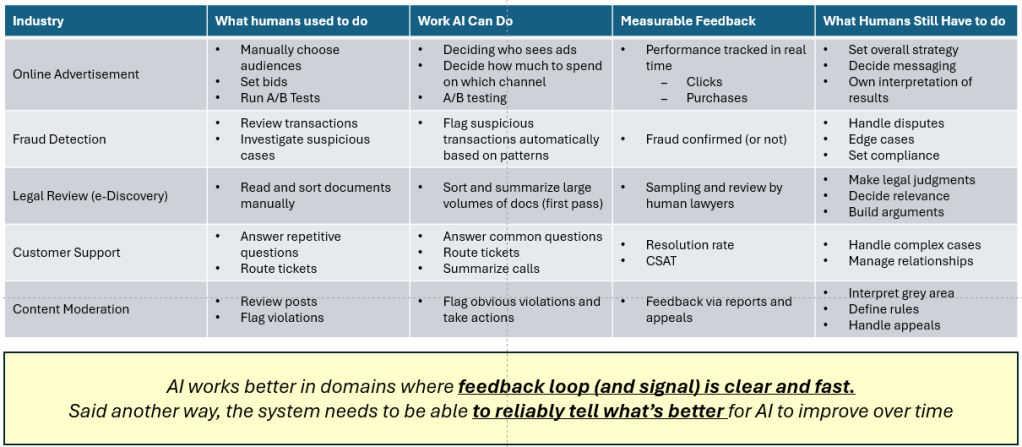
One common feature across domains with productive AI adoption is the presence of a clear and fast feedback loop, allowing systems to generate and iterate on “good-enough” first drafts of work. However, the second-order effects become more nebulous as workflows scale and reliance on AI increases without proportional human oversight.
In software engineering, for example, tools like GitHub Copilot, Codex, and Claude promise meaningful productivity gains by accelerating code generation. However, there’s recent evidence suggests that these gains may be overstated. Some studies show that developers who report feeling faster are, in reality, slower when accounting for the additional time required to review, validate, and correct AI-generated code (Developers Feel 20% Faster With AI. They’re Actually 19% Slower). This highlights a tension: AI shifts the bottleneck from production to judgment. AI can reduce the time required to an initial output, but the effort required to ensure its correctness and reliability also increases.
In the meantime, the rapid increase in speed has created strong incentives for the management to commit early to the automation-led productivity gain. While productivity improvements are easier to quantify by measuring output volume in a given time period, the cost of verification, reduced depth of understanding and the systemic error that compounds in the background have been more difficult to observe and quantify. In some sense, as speed and progress have become more synonymous, the system has nudged us towards abundance of mediocrity rather than progress.
In many high-stakes domains (think running a company, M&A, public policy, biology, etc.), “good” is rarely clean. It involves tradeoffs and externalities that don’t fully fit into a neat loss function. AI can generate options and even suggest better objectives. But we have to choose which object should be adopted. Even in cases where AI surpasses humans (think chess, Go, or even Alphafold’s protein folding), the system works because the objective “good” is tightly specified by us. Only then the model can be iterated and optimized. These breakthroughs were possible, not because of AI’s ability to execute at scale, but because we could claim what “good” means.
In any decision-making process, there comes a point when options turn into commitments. We call this judgment. AI does not absorb the downside risk when it is wrong. It’s our judgment that bears the full weight. It requires not only the balancing of tradeoffs, but also an acceptance of uncertainty itself and the ultimate consequences. AI may surface possibilities but it cannot internalize the responsibility. It simply does not scale with compute.
In the age of AI, progress will be driven by our authorship of which systems to employ and to define what “good” is worth pursuing. This places value on those who can articulate standards, make tradeoffs, and stand behind their decisions. Since value accrues to whoever underwrites the risk, not whoever produces ideas. we must invest in more people capable of defining and defending what “good” looks like.
Miyazaki’s refusal to adopt AI-generated art has never really been about the technology’s capabilities. On the contrary, many images produced by AI are often striking, and even beautiful. Rather, his stance is about something else: a commitment to authorship grounded in human experience. In this choice lies a distinction that cannot be optimized away.
As AI grows more capable, the question before us will be not about whether something can be produced. It will be about what ought to be, and under whose name. In the coming decades, it will not the abundance of mere outputs that defines our progress. It’s the care with which we decide what is worth making and our willingness to bear the cost of having made it.


Leave a Reply